
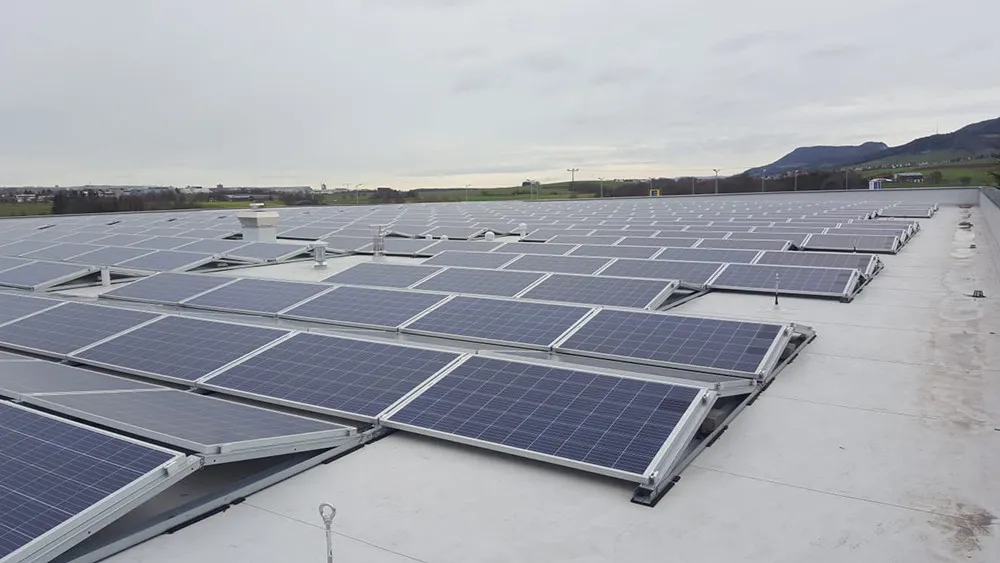
Installing photovoltaic systems is always a major challenge for you as an installer and builder of PV systems.
Here are a few tips for a smooth process and carefree installation:
- Pay attention to damage and the condition of the roof cladding during the inspection. Be sure to document any existing damage to the roof cladding with photos and have the current condition confirmed by your customer and the roof owner. Insist on inspecting the roof from below as well. If there is obvious water damage, have this also documented and confirmed.
- Measure the roof precisely, especially the superstructures. Planning based on a Google Earth image is far too imprecise. With large antennas, consider not only the shading, but also the possible ice throw.
- Maintain the necessary distances to fire protection-relevant superstructures (RGA, fire protection walls). Please observe the local official regulations here. As a rule, distances of between 0.5 and 2.5 m must be maintained. In the case of skylight domes that serve as RGA, the direction of impact must also be taken into account, as these must always be kept clear.
- Ask about the load reserve of the roof. As a rule, we require between 9 and 18 kg/m² for the TRITON system. Of course, you will always receive a project-specific ballasting plan with the standard-compliant safety values of 1.5 against lifting and shifting as well as all relevant information.
- When installing, ensure that the distance from the edge of the module to the outer edge of the roof is as close to 0.8 m as possible. This means you need significantly less ballast.
- Fill out our ▸Recording form completely. This ensures quick and smooth planning and ballasting.
- If there is a lightning protection concept on the roof, ask the roof owner or his lightning protection officer how to proceed with the PV system. The TRITON system can be integrated passively and actively. Our system is currently being certified as VDE-compliant.
- Observe the applicable standards for frame and module earthing.
- If there is fall protection on the roof, this must always remain free. Discuss this with your customer and the roof owner. Fall protection can also be integrated into the TRITON system after consultation with us.
- For inclinations greater than 3°, the system must be secured against drifting down the slope, as otherwise the PV system may “wander” over the years despite correct ballasting. We have several technical options for securing the system. We will be happy to support you.
- Observe the applicable safety regulations during installation and keep your distance from the edge of the roof. Read our installation instructions carefully.
- Check whether you can place the module pallets and the TRITON system pallets on the roof (high local load!). Always cover these standing areas with a protective fleece or building protection mats to prevent damage to the roof cladding. This is also recommended for frequently used walkways. Issue a complete smoking ban on the roof and scaffolding.
- Always adhere to our ballasting plan. If there are any changes during construction, please let us know so that we can adapt the plan.
- Make sure that the stones required as ballast (usually standard paving stones) are placed correctly.
- Metal parts and stones must not be in direct contact with the roof cladding.
- Use aluminum-laminated building protection mats for films. In this case, you do not need proof of compatibility with the foil, as the aluminum lamination is considered a structural separation. For all other coverings, the building protection mat without aluminum lamination is recommended, as the coefficient of friction is higher here.
- Ensure professional cable routing in suitable cable ducts.
- Document the condition of the roof after completion of the installation work and carry out an inspection with the customer and the roof owner. Have this also confirmed.
- Inform the customer that the system must be inspected annually and after heavy storms.

















0 Comments