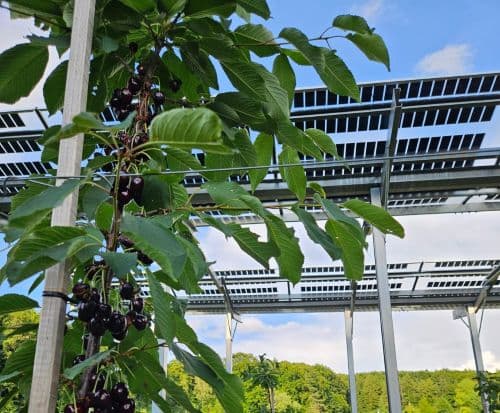
Agri-photovoltaics (Agri-PV) combines agricultural use and solar power generation on the same area with the aim of reducing competition for land and enabling farming to continue. A clear roadmap is required to ensure that an agrivoltaic system can be installed quickly and safely. We have put together the following project schedule for privileged agri-PV projects in outdoor areas.
Phase 0: Examination of the privileged status of the Agri-PV facility in accordance with BauGB §35 Para. 1 No. 8 or No. 9
The first step in planning an agri-PV system is to clarify whether it is fundamentally privileged. If so, no land-use planning (development plan) is required, which can speed up the entire project considerably. Important: A building application is usually still necessary!
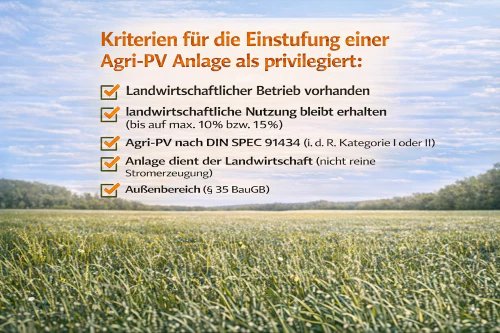
The actors involved in this first project stage are the farmer and the project developer. In the end, the decision is made as to whether an Agri-PV project can be classified as privileged or not. If this is not the case, land-use planning is required. A simplified procedure is possible for privileged installations.
Phase 1: Site analysis & feasibility study for Agri-PV projects
If the Agri-PV project is classified as privileged, the next step is a basic assessment of the potential site and the development of an initial, robust concept. This includes a rough layout and a profitability assessment.
Contents of the first rough layout of an Agri-PV system:
- Land suitability (topography, soil, cultivation)
- Rough concept Agri-PV (elevated / vertical / tracker)
- Yield & profitability (EEG / PPA): For privileged projects, either self-consumption of electricity or an EEG remuneration is generally appropriate.
- Rough environmental sensitivity (protected areas, biotopes, possibly flagship species)
Actors involved in this project stage:
- Farmer
- Project developer
- T.Werk can already be consulted here in an advisory capacity
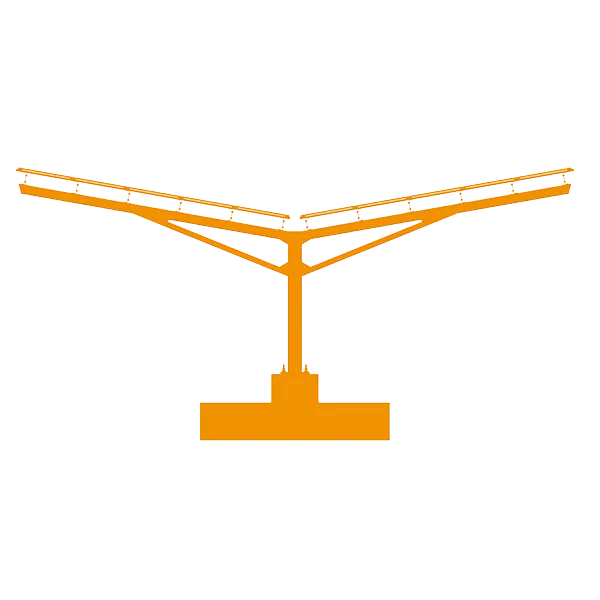
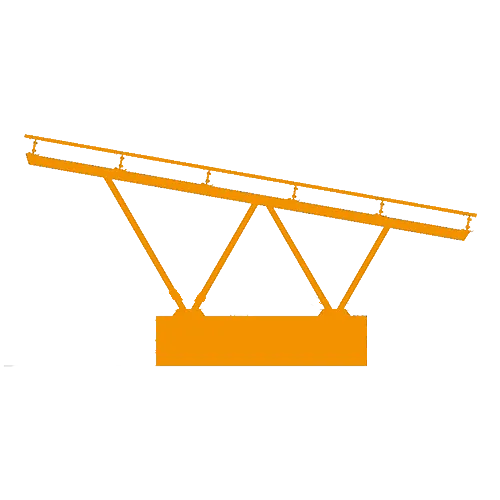
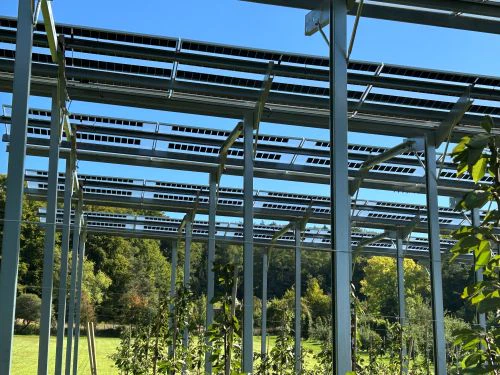
The result of this project step is the development of a preferred variant for Agri-PV (Category I – high-mounted or Category II – close to the ground) as well as an initial project profile as a basis for the further course of the project.
Phase 2: Coordination of the framework conditions for the Agri-PV project
The most important framework conditions are now being clarified with the relevant authorities before time and budget are invested in the detailed planning. This includes discussions with the district office, building authority and lower nature conservation authority as well as an early grid inquiry with the grid operator in order to secure the approval process, testing requirements and connection options. This often significantly reduces subsequent delays.
Goals:
- Confirm privileged status (can also be confirmed or underpinned by ABCert)
- Clarifying the scope of environmental assessments
- Determine approval path (depends on privilege)
- Obtain network statement in order to be able to plan further
Actors involved in this project stage:
- District office (= approval authority for privileged projects)
- Lower nature conservation authority (UNB)
- Building authority, if applicable
- Network operator

Phase 3: Environment & nature conservation at Agri-PV
It is then checked which species protection and nature conservation requirements apply to the site and which expert opinions are required.
Environmental and nature conservation assessments for Agri-PV projects:
- Preliminary species protection assessment (saP)
- Mapping (breeding birds, amphibians, reptiles, bats, insects, migratory and resting birds – not all absolutely necessary!)
- Construction time regulation
- Avoidance and mitigation measures
- CEF measures if necessary
Phase 4: Technical and agricultural planning of the Agri-PV
The Agri-PV project is now being developed so that it is ready for approval. The substructure, module assignment and electrical components are planned and at the same time the agricultural use (e.g. passageways, working heights, crops) is verified in the utilization concept.
| Technical planning: | Agricultural planning: |
| Substructure (height, center distance, other configurations) | Type of farming (arable farming, grassland, special crops, livestock farming) |
| Modules | Machine passages (width, height) |
| Irrigation and drainage concept | Safeguarding agricultural yields |
| Transformer station | |
| Inverter | |
| Memory, if applicable | |
Actors involved in this project stage:
- Project planner with farmer
- Building authority
- Chamber of Agriculture
The result of this project step is an elaborated design and approval plan (for privileged projects a building application including agricultural utilization concept and module allocation plan)
Phase 5: Grid inquiry, grid commitment and revenue model for Agri-PV
The next step is to set the decisive course for grid connection and profitability. From the grid inquiry to the grid approval, it is clarified whether the system can feed into the grid at all, and if so, at what capacity. At the same time, the appropriate revenue model is determined, e.g. EEG remuneration, direct marketing or PPA. If necessary, the financing is also prepared. This creates a reliable basis for the planning application, investment decision and schedule.
Phase 6: Approval of the Agri-PV system
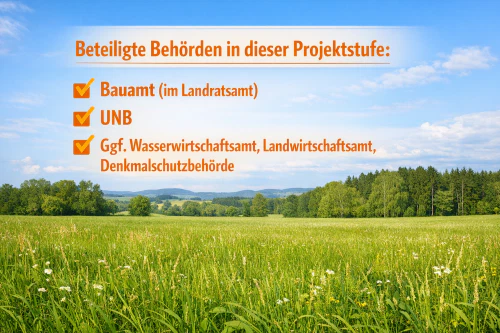
All technical, agricultural and environmental documents are then bundled together and submitted as a complete planning application, even if the project is privileged. The authority then checks the documents and, depending on the project, involves other specialist bodies until the approval notice is issued.
Documents for an Agri-PV building application
- Site plan
- Final module allocation plan
- Pile-driving plan based on the measured area
- Construction drawings (e.g. system cross-section)
- Technical descriptions
- Environmental documents
- Proof of privilege according to §35 BauGB
- Agricultural utilization concept
Phase 7: Construction preparation of the Agri-PV
Once planning permission has been granted, the project is prepared for implementation in organizational and practical terms. The following steps are necessary for this:
- Tender / award to EPC or general contractor
- Construction schedule (observe species protection), compensatory measures if necessary
- Site equipment
- Activate ecological construction monitoring
Phase 8: Construction and implementation of the Agri-PV
The Agri-PV plant is now being realized on site. At the same time, approval and nature conservation requirements are consistently adhered to and documented in order to avoid delays. At the end of the process, the technically completed system forms the basis for acceptance and commissioning.
Procedure for installing an Agri-PV system
- Complete preparatory construction measures
- Surveying
- Ramming
- Mounting substructure
- Install irrigation/drainage if necessary
- Module assembly
- Electrics & transformer station
- Mains connection
Phase 9: Acceptance & commissioning of the Agri-PV
Once the Agri-PV has been successfully installed, the completed system is technically inspected and officially handed over to the grid operator and operator. This includes acceptance by experts and grid operators as well as formal commissioning, including the necessary notifications (e.g. in the market master data register). Only then can the Agri-PV system generate and market electricity on a regular basis.
Phase 10: Operation & monitoring
The Agri-PV system is now in regular operation with permanently secured agricultural use and reliable electricity production. Through monitoring, maintenance and documentation, yields, plant availability and compliance with regulations and compensation measures are continuously checked. This ensures that the project remains economically viable in the long term.