Photovoltaics has become a cornerstone of electricity supply in Germany. At the same time, expansion is far from complete. The publication “Current Facts on Photovoltaics in Germany” by the Fraunhofer Institute for Solar Energy Systems ISE shows the significance of solar energy today and the potential that can be tapped in the coming years.
Photovoltaics Continues to Grow
The expansion of photovoltaics in Germany has gained significant momentum in recent years. In 2025 alone, approximately 17 GWp of new PV capacity was added. This brought the total installed capacity to around 118 GWp, distributed across roughly 5.5 million systems, including plug-in solar devices.
For comparison: between 2013 and 2018, the average annual addition was only 1.9 GWp. The development in recent years clearly demonstrates the momentum the German photovoltaic market has now achieved. And expansion is set to continue: the legally mandated expansion pathways target an installed PV capacity of 215 GWp by 2030 and 400 GWp by 2040. This means demand for new photovoltaic systems will remain high in the coming years.
Solar power has long been an important part of our electricity supply
As expansion grows, so does the importance of photovoltaics for Germany’s electricity supply. In 2025, PV systems generated approximately 92 TWh of solar electricity according to Fraunhofer ISE. Photovoltaics thus covered about 17 percent of Germany’s gross domestic electricity consumption. Renewable energies overall accounted for around 55 percent.
By 2030, their significance is likely to increase further: if the expansion target of 215 GWp is achieved, solar electricity could contribute around 30 percent to gross electricity consumption according to Fraunhofer ISE calculations.
Germany’s Roofs Offer Enormous Potential
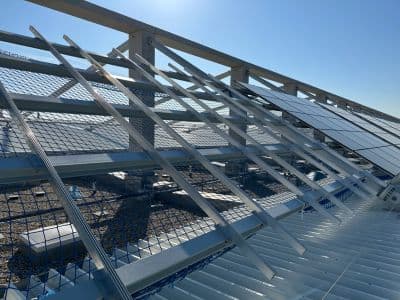
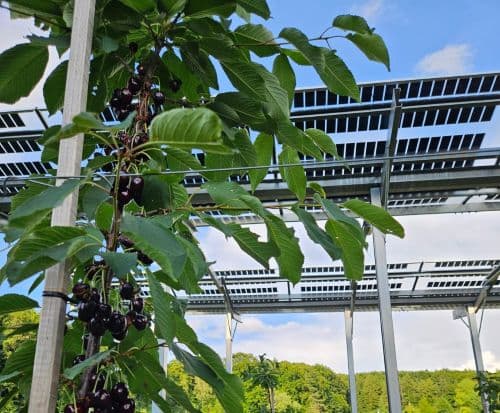
For further expansion, the question inevitably arises: are there sufficient suitable areas? The answer from Fraunhofer ISE is clear. In addition to open spaces, agri-photovoltaics, parking lot canopies, or floating PV, existing buildings in particular offer significant potential.
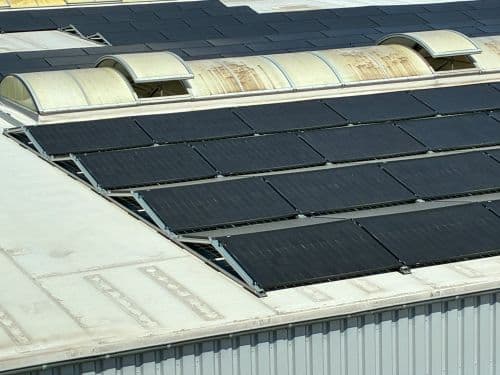
Germany has approximately 40 million buildings. According to the study, their roofs and facades alone have a technical photovoltaic potential on the order of 1,000 GWp. At the same time, less than ten percent of the existing roof potential is currently being utilized. Commercial, industrial, and logistics buildings with large roof areas can therefore play an important role in further PV expansion.
Expansion increases demands on the overall system
The greater the share of photovoltaics in electricity supply becomes, the more important its integration into the entire energy system becomes. Expanding PV generation capacity alone is therefore not sufficient in the long term.
In parallel, electricity grids must be developed further, storage expanded, and electricity consumption and generation more closely coordinated. The increasing electrification of mobility and heating also offers opportunities to use solar electricity directly.
Photovoltaics is thus increasingly becoming part of a networked energy system of generation, storage, and consumption.
Quality becomes increasingly important in further PV expansion
The figures from Fraunhofer ISE clearly show: Germany is not at the end of photovoltaic expansion, but is in the midst of a long-term transformation. To achieve the planned expansion targets, large amounts of new PV capacity must be installed in the coming years as well.
This brings quality of systems into sharper focus alongside the speed of expansion. After all, photovoltaic systems are designed for decades of use. Modules, substructures, and other system components must therefore not only enable rapid installation, but also function reliably over the long term and be adaptable to different roof conditions.
Conclusion: Photovoltaics remains a growth market
With 118 GWp of installed capacity and a share of around 17 percent of gross electricity consumption, photovoltaics already has a firm place in the German energy system today. At the same time, expansion targets and available area potential show that a significant part of the journey still lies ahead.
The use of existing roof areas in particular offers great opportunities. For planners, installers, companies, and building owners, this means: photovoltaics will remain a central component of the energy transition in the coming years and thus a market with long-term growth potential.
To the complete publication by the Fraunhofer Institute for Solar Energy Systems ISE.