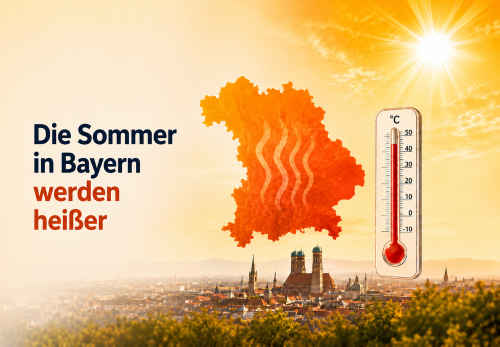
Bavarian Broadcasting’s Fact Fox comes to a clear conclusion in an analysis of summer temperatures: Summers in Bavaria are not simply “like before,” but have become measurably hotter. The decisive factors are not individual warm days or cherry-picked extreme years, but long-term measurement series.
According to the German Weather Service, a hot day is a day with a maximum temperature of at least 30 degrees Celsius. It is precisely these hot days that have significantly increased in Bavaria. From 1951 to 1999, there were only five years with ten or more hot days on average across Bavaria. From 2000 to 2025, however, there were already eleven years, although this period is only about half as long. Particularly hot years included 2015 with 25.6 hot days, 2003 with 24.3, and 2018 with 18.1.
Tropical nights are also increasing. These are nights when the temperature does not drop below 20 degrees Celsius. In Bavaria, the average rose from 0.025 tropical nights per year in the period 1961 to 1990 to 0.2 in the period 1991 to 2020. This is particularly noticeable in cities, as asphalt, concrete, and buildings heat up during the day and release heat more slowly at night.
The central point of the BR Faktenfuchs is therefore that while there were individual hot summers in the past, the frequency, intensity, and duration of heat events are increasing. Climate change has therefore long since arrived in Bavaria.