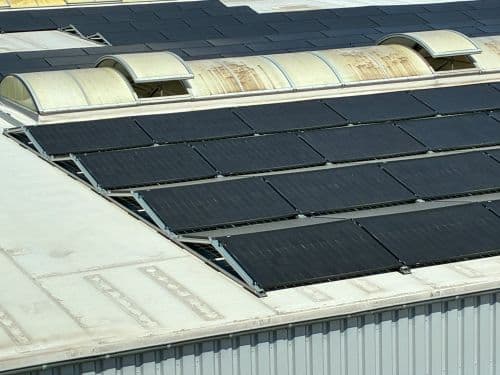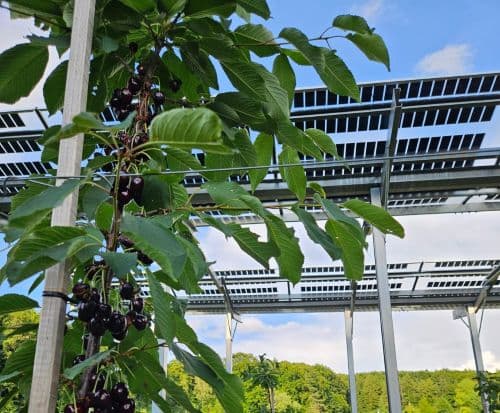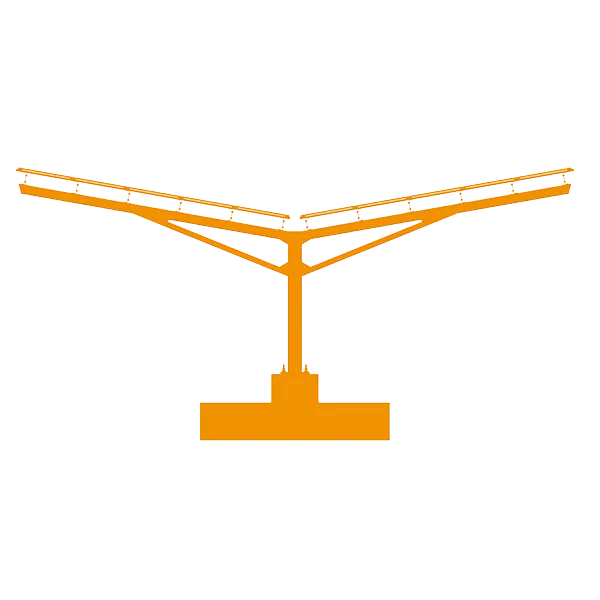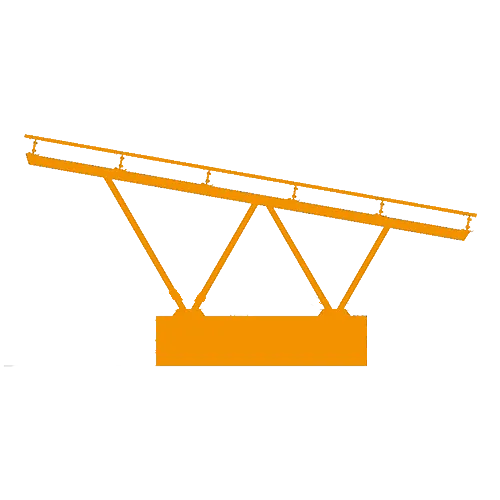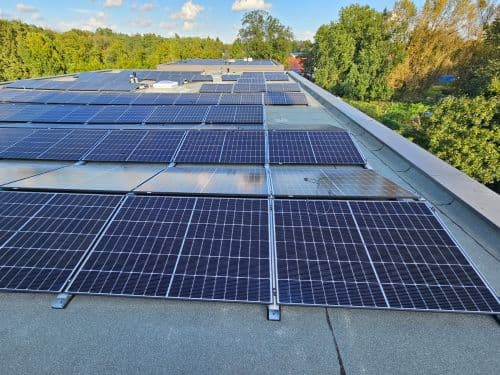
When planning non-penetrating photovoltaic mounting systems on flat roofs, wind load calculation plays a central role. It forms the basis for determining how much ballast is required to ensure a system remains securely on the roof over time. Particularly for aerodynamically optimized systems such as TRITON, TRITON flora, and METIS, precise and code-compliant calculation is crucial.
A seemingly unusual behavior is frequently observed: for certain building dimensions, the required ballast initially decreases as the building height increases. At first glance, this appears surprising, as it is generally assumed that wind load automatically increases with building height.
Why can wind load on the roof decrease with increasing building height?
With constant plan dimensions and increasing building height, the wind flow around the building changes. The taller a building becomes relative to its footprint, the more the airflow is directed laterally around the facades. At the same time, a smaller proportion of the air flows over the roof. This reduces the acceleration of the airflow on the roof surface. Consequently, the governing pressure coefficients for the roof also decrease. These pressure coefficients can decrease more rapidly with increasing building height than the dynamic pressure increases due to the greater height.
The result: In certain height ranges, the calculated wind load on the roof and thus the required ballast can initially decrease.
Safety Limitation Above 25 Meters Building Height
Important: This decrease is not continued indefinitely. For safety reasons, it is limited at a building height of 25 meters. For buildings over 25 meters, the pressure coefficients do not decrease further. At the same time, the dynamic pressure continues to increase with height. As a result, the required ballast increases again from this range onward.
Conclusion
In wind load calculations, building height alone is not the deciding factor. The ratio of building height to plan dimensions and the resulting flow over the roof and facade also play an important role. For planners, partners, and users of our T.Konfigurator, this means: Even if ballast decreases at certain building heights, this calculation is based on comprehensible aerodynamic effects and simultaneously incorporates conservative safety limits. This produces reliable, safe, and economical ballast specifications for our PV mounting systems TRITON, TRITON flora, and METIS.